What change, big or small, would you like your blog to make in the world?
The vision was simple for this blog. Share my knowledge and experience surrounding epilepsy so that others may feel empowered and seen. The stigma surrounding epilepsy continues to hold much misconception.
How little did I know that my commitment to the blog only fed my feelings of failure. The fatigue of my chronic illness didn’t allow me to write on the manner and as often as I originally envisioned.
White lilacs and the color purple represent epilepsy awareness
So often with chronic illness, life drastically changes, and you find that you can no longer do something that you used to do with ease. This may not be the grand writings that I imagined, but it’s what I can do right now.
Perhaps someday, as medicine and technology advances, I will be able to do more.
If you are interested in learning more about epilepsy visit my frequently asked questions post to become informed and help stop the stigma.
Moving into a new home is more than just unpacking boxes—it’s an opportunity to re-imagine your life and the way you live it. Whether you’re settling into a cozy apartment or upgrading to your dream house, this blank canvas comes with incredible advantages. Here are four powerful benefits of moving into a new space, and how to make the most of them.
—
Intentional Living: Design with Purpose
1. Each room in your new home is a fresh start. Think intentionally about how you want to use each space—what do you envision doing there? Maybe that sun-filled room with wide windows becomes your morning coffee haven or a creative workspace.
Pro tip: Start simple. Only bring in furniture and decor that serves the space’s purpose. And remember, your first choice doesn’t have to be permanent—your needs and lifestyle may evolve, and your home can evolve with them.
—
Spark Creativity with Signature Pieces
2. Let the items you love inspire the entire room. Is your bold red armchair your favorite? Or maybe that blue-green art piece holds sentimental value? Use these cherished items as anchors for your design decisions.
Avoid this common mistake: Buying curtains or rugs before knowing how your signature pieces will fit in. Build your space around what you already love—this saves time, money, and stress.
—
Declutter and Purge
3. Moving is the perfect time to ask: Does this add value to my life—or just take up space? Hopefully, you’ve already donated items that no longer serve you. Unpacking becomes much easier when you’re only surrounded by what truly matters.
And don’t worry if you second-guess things post-move. We’ve all looked at that one item and thought, “Why did I bring this?” Use it as a cue to keep editing your space until it feels right. If you need inspiration or help with decluttering or are interested in minimalism check out my attempt at minimalism.
—
Embrace the Joy of Experimentation
4. One of the best parts of a new space? The freedom to explore. Try new arrangements, paint colors, or furniture placements without fear of getting it wrong. Your first setup doesn’t have to be final—it’s just your first chapter.
Let go of perfection. Your home isn’t just a showplace; it’s where your life unfolds. Have fun with it. Every tweak brings you closer to a space that truly feels like you.
—
Final Thoughts
A new space offers the gift of reinvention. With intention, creativity, clarity, and playfulness, you can create a home that supports the life you’re building now—and the one you’re dreaming of.
What are your best tips for moving into a new space? Comment below. —
Epilepsy will never be cured. Especially mine, not in my lifetime, not this intractable, unknown caused, epileptic brain.
All living things are mortal- life is too short, live and enjoy it while you can. Go explore, learn, and experience while you still have the capacity to.
The Second Law of Thermodynamics – The Second Law is often cited as the reason for the “arrow of time.” The universe is observed to be evolving from a state of lower entropy (the Big Bang) to a state of higher entropy, giving time a direction. In simpler terms, heat flows from hotter to colder environments. This is how I keep myself warm, by sucking the warmth out of others.
Change is constant – you are a speck on top of a world rotating around the sun. This sun is rotating around a universe, rotating around a galaxy rotating around a solar system rotating several galaxies. All plunging through space together because… we exploded together. That is wild to think about. So technically on a base level, you are truly forever in motion. So if someone tells you to “get off the couch and get moving” you can tell them you have! But I wouldn’t recommend the response unless you want to keep your job, relationship, or allowance.
You are reading this sentence. This is a direct, undeniable experience you are having right now. At some point, you had past experiences that led you here. And you will make choices from this moment that will influence your path forward. Your life is partially a creation of your choices.
Photo by Sergio Scandroglio
Every person is unique. Even those who share the same DNA. Their perspective and their communication is entirely their own and should be respected within reason.
To learn, you must admit you do not know. This is extremely difficult, especially as you become more well versed in a subject and your ego gets in the way.
The energy spent on the focus of what others may think is useless. It is very likely that they are spending a lot less time thinking about you than what you are assuming they are. Dress, put on makeup, dance for you, no one else.
You can only control your own emotions, actions, and decisions.
Beliefs should conform to one’s best scientific understanding of the world. One should take care never to distort scientific facts to fit one’s beliefs. – TST
“The Greatest Thing, You’ll Ever Learn, Is Just to Love, And Be Loved, In Return.” – Nature Boy by Nat King Cole
Your thoughts?
Do you agree with any of the above? Why or why not?
My formal education background is in STEM. I grew up in a household where there was always analysis and a solution. Naturally, when there is a problem in my life, whether it be professional, romantic, or fiscal, I approach it with logic.
Recently, I have started to watch the show Mr. Robot. If you happen to never have heard of it, it is about a young man, Elliot, with social anxiety who works in cyber security, yet is a vigilante hacker. He is very against corporate America despite working for it. He falls into an intense situation where his morals are questioned. I refuse to give any spoilers, but so far the show is phenomenal.
It’s all just 1s and 0s
At one point in the show Mr. Robot is telling Elliot that life does not have any grey areas; It is all 1s and 0s. This has been a concept I have been struggling with for some time.
Not because I disagreed, but because I agreed.
Photo by Rada Aslanova
Let me give you an example using my relationships. I’d perform an assessment, and if I detected – or if the other person vocalized – anything less than 100% commitment, a “1,” I would end the relationship immediately. There was no grey area: if it wasn’t a “1,” it was a “0,” a complete “out.” I refused to dedicate my energy to a relationship lacking that full investment. Some might interpret this as Anxious-Avoidant Attachment, though I haven’t undergone any formal assessment.
Security or Adventure?
Recently, my binary approach has been thrown into question. Security and adventure are not mutually exclusive. As my partner says, it’s about balance.
I am seeking security and adventure. It is possible to have a reliable relationship with emotional stability with somebody who you can share wonderful adventures. I know it exists.
The ideal blend of the two will likely change as life progresses, and priorities change. But I plan to be intentional on not letting my binary approach let my pursuit of stability undermine my need for adventure and stifle my love for growth and learning.
What Are Your Thoughts?
Do you see the world in 1s and 0s? Do you prefer to live in the grey?
What could you let go of, for the sake of harmony?
Getting a diagnosis of a chronic illness, or even experiencing an injury that fundamentally alters your life’s path, can be absolutely devastating. The initial shock, the grief, the fear – these are powerful emotions that are unlikely to remain static. Your feelings today are not what they were yesterday, and they will almost certainly evolve in the months and years to come.
My first piece of advice is simple: take things day by day.
Photo by @epil_epsy_ogue
It takes time to process such a monumental shift. For me, it took five years to truly begin resetting my way of thinking. I had once made plans to move far away, back to a place I’d lived before, but that location was distant from my family and my vital support system. My career aspirations also underwent a radical transformation. As I came to terms with the possibility that I might never drive again, I began researching careers that significantly reduced the need for me to be driven frequently.
This journey is one of constant development. It’s about gently letting go of who you used to be, and with it, all your original plans and expectations. This isn’t an ending; it’s a powerful shift. “This is who I am now,” I tell myself, “and I am okay with it.”
It will indeed be a long journey, filled with days that are better than others. And it’s perfectly okay to not be okay! Feelings of frustration, disappointment, and even anger are normal.
There will be things you once enjoyed doing that you can no longer participate in, and it is right and healthy to mourn those losses. But remember, you are still that same great person. Your contributions to the world may simply take a different form. You can absolutely still be a dignified, social, and beautiful person, despite an illness.
In the context of these feelings, achieving harmony refers to a state of inner peace and balance that can exist despite challenging external circumstances or waves of negative emotions. I admit, this is far easier said than done.
Photo by Shiva Smyth
It’s about cultivating an equilibrium within yourself, where diverse emotions, thoughts, and experiences can coexist without spiraling into internal conflict or distress. This often involves practicing positive self-talk, leaning into your core beliefs, and grounding yourself with the support of friends and family to maintain a stable emotional state.
For the sake of this inner harmony, I am actively working to let go of my expectations of perfection for my future. I encourage you to join me on this journey.
How would you answer the question above? Let me know in the comments.
Living with chronic illness comes with its own set of challenges, and one of them is dealing with people’s reactions when you tell them about your medical condition. Here are five common responses and suggestions on how to handle each situation.
1. “At least it’s not cancer.” And if it is cancer, at least it isn’t this particular type of cancer, or you would have died already. It’s disheartening when others downplay your experience by comparing it to different conditions or other people’s situations.
Remember, their comments are not about you, but about their own discomfort with the topic of any chronic illness. For your own mental and physical health, it’s best to ignore these remarks.
2. “I know the cure.” They had a cousin, who knew a guy, whose wife did this regimen and now she’s cured! So you should definitely do that so you can get cured too. (Even though there is no cure to your illness.)
Many well-meaning people may suggest unproven remedies or miracle cures, despite lacking any medical knowledge about your condition. Politely acknowledging their advice while asserting that you have a team of medical professionals guiding your treatment can help maintain boundaries and prevent further unwanted recommendations.
3. “Well, you don’t look sick.” This response stems from their preconceived expectation of how chronic illness “should” look, and if you don’t fit inside their stereotypes, it causes people to doubt your experience. Educating as many people about not all illnesses are visible may foster understanding.
But if you have already calmly explained the concept of invisible illness and how it impacts your daily life and they still do not believe you, it is best to accept that not everyone will comprehend your personal trials.
4. “Tell me more about…” Some individuals genuinely want to learn about your condition. While it might be intimidating at first, try to embrace these opportunities to educate others about your chronic illness. Increasing awareness can combat misconceptions and help create a more compassionate environment. If you find reliable resources, apps, websites, even influencers that provide accurate information about your specific chronic illness, so you can help educate others, Who knows, they may even become advocates to raise awareness in turn!
5. “Your struggles are powerful.” Over-sympathizers might shower you with well intentioned prayers and sentiments, but their constant emphasis on your epic struggles can be overwhelming. They may have the best intentions, yet we do not need to be reminded that we struggle every day. We live it; we know. Remember that you are more than your illness, and it’s okay to politely remind them that you appreciate their support while still maintaining personal boundaries.
Have you encountered any of these responses when disclosing your chronic illness to someone new in your life? What was your response?
I am the epitome of idleness; not because I am lazy but because of my chronic illness. My uncontrolled epilepsy causes multiple seizures throughout the day and status epilepticus at night, leading to constant exhaustion. Even a simple task can consume all my energy, let alone anything physical. Just existing uses up more energy than the average person.
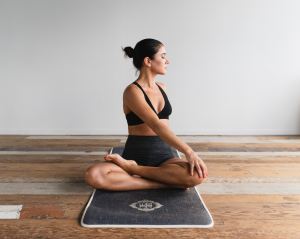
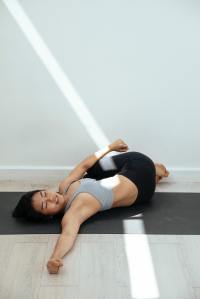
So I challenged myself to stretch every day for 31 days, to see if it could make a difference. Now, 31 days does not create a habit. It takes anywhere from 18 to 254 days, as science suggests. Nonetheless, I wanted to try to condition my body to a point that stretching wouldn’t seem like extra effort.
What does stretching do to your body?
The muscles are a fascinating fiber in our body. When we stretch, the fibers have the ability to maintain elongation, unlike a rubber band that just snaps back to its original shape. However, to maintain that elongation, regular movement within that range is necessary.
As we age, the elastic fibers in our body regenerate less effectively, causing a reduction in movement range and muscle stiffness. Thus, movement and stretching become increasingly important as we grow older. For more information on the significance of movement, check out my other article Movement Matters.
Week 1
Initially I was unsure of how to begin. With no established routine, I was randomly stretching exercises. Then, I discovered a free app called Female Fitness – Women Workout. It offers targeted stretching routines such as full body, morning warm up, sleepy time stretch, and even splits training. It was the perfect place to start for the person who lacked direction. I also found a YouTuber who specialized in stretching techniques which allowed me to gain more knowledge along my journey. Below, is one of his videos of a easy 10 minute stretch, for any skill level, if you are interested in checking out his content.
Week 2
During this week, something surprising happened – I began to look forward to stretching. I found myself taking breaks to stretch my body, and even found ways to incorporate stretching while working. At this point I had established an actual stretch routine. Here were my rules:
Engage my entire body in stretching – this did not apply to the stretches I did while I was still actively working at my computer or doing another activity. This meant I was dedicating time to actually do a full body stretch.
No time restrictions. – I wanted to stretch until I felt good, not until the clock/timer said I was done.
I stretched to discomfort, not pain. Once the discomfort disappeared, I would push a little further.
Week 3
By week three, a shift occurred in my mindset. I no longer needed the distraction of YouTube to complete a stretching session. It was the first time my body had moved since my brain surgery, and I never rebuilt an emotional connection to physical movement. But when I focused on how I felt, physically and emotionally as I flowed from one position to the next, I realized it was a peaceful experience.
After consistent stretching, I began to see physical results. I even noticed a significant difference in my overall flexibility. Am I ready to join Cirque Du Soleil? I think not. But incorporating movement into my day made a difference. Even the smallest amount of movement of our body can increase blood and fluid supply to our bodies. The small results I achieved during these 31 days have motivated me to continue stretching beyond this challenge.
What kinds of benefits do you find from stretching? I would love to hear about your stretching routine, leave it in the comments below!
Is epilepsy just where you fall on the floor and shake? Epilepsy is a neurological condition that causes recurrent seizures. There are many types of seizures that present themselves in different ways. Most people are familiar with generalized tonic-clonic seizures, where a person loses consciousness and muscles get stiff and rhythmically jerk on both sides of the body. However, there are other types of seizures to be aware of:
Tonic seizures: muscles in body, arms, or legs become stiff or tense which can cause a fall.
Clonic seizures: rhythmical jerking movements in the arms or legs.
Infantile epileptic spasms: the body contracts and extends repeatedly; presenting like a startle reflex; this occurs within the first year of life.
Atonic seizures: muscles become weak, limp, or numb; these are also known as a “drop seizure”
Myoclonic seizures: brief muscle twitching occurs while the person remains alert.
Focal Aware seizures: the person stays alert but experiences involuntary motor moments or sudden changes in emotional state, thinking or cognition, behavioral arrest, and autonomic function
Focal Impaired Awareness seizures: the person loses awareness, and likely will not remember the event; seizure can present as sudden changes in emotional state, thinking or cognition, behavioral arrest, and autonomic function
Absence seizures: these present as a blank stare and the person’s eyelids may flutter
I’ve just been diagnosed, where do I find support? Epilepsy Foundation is a United States based organization that has many resources for people and families impacted by epilepsy, in all age groups. You can visit their website to find the right support group for you by clicking here. They even have bereavement support for those who have lost a loved one to SUDEP.
What is SUDEP? Sudden Unexpected Death in Epilepsy. It is more likely to occur in people with poor seizure control and status epilepticus. According to the Epilepsy Foundation, more than 1 out of 1,000 people with epilepsy die each year from SUDEP.
I am on a medication, but its been 3 months and I am still having seizures. What can I do? Talk to your primary care physician or pediatrician, you may need to see an epileptologist (a neurologist who specializes in epilepsy) or neurologist at a level 4 Epilepsy Center.
What is a Level 4 Epilepsy Center? A level 4 epilepsy center is accredited by the National Association of Epilepsy Centers and provides the highest level of care for people living with epilepsy and other seizure disorders. These locations have advanced neurodiagnostic monitoring equipment. If surgery is a treatment option for a person living with epilepsy, it will be preformed there. You can find a Level 4 Epilepsy Center near you by visiting the National Association of Epilepsy Centers’ website.
When would surgery possibly be a treatment option for my epilepsy? That would be a decision between you and you medical provider. However, if you have tried 3 or more medications and they have failed to control your seizures, further evaluation is recommended at a Level 4 Epilepsy Center. This evaluation would likely include, neuropsycholoical assessment, genetic testing, Video EEG, CT, MRI, magnetoencephalography (MEG) and possibly other tests. Depending on your type and location of seizures your epilepsy team will recommend the type of surgery that would be most effective for you.
There is more than one type of surgery for epilepsy treatment? Yes, there are sever surgical options including device implants, laser therapy, disconnection, and resection or removal of the portion of the cause of the seizures. Depending on your testing results you may be a candidate for more than one of these surgeries. To read more about my surgery journey click here.
Is there a cure for epilepsy? No, unfortunately there is no cure for epilepsy. There are some very effective treatments (like those mentioned above) that do reduce seizure frequency and improve quality of life for approximately 60% of patients with epilepsy. It is important to work with a medical team that specializes in epilepsy and any other medical conditions you have to find the best treatment plan for you.
Do you have any questions about epilepsy? Let me know in the comments below, send me a private message via my contact form, send me a DM on Instagram or Twitter.
Undergoing brain surgery can be a daunting experience, but being well-prepared can help you feel more at ease heading into the process. You have read everything about the surgery itself. You have the instructions from the hospital, and the surgeon. But maybe you want a little more of and insider tip from someone who has been there, done that. Well you have come to the right place!
Here are ten essential things to get ready before your surgery, along with a bonus to consider at the end.
1. Baby (Gentle) Shampoo: Harsh chemicals can be detrimental to healing incisions. Baby or natural shampoos are usually safe, but please check with your surgeon if you are unsure. Liquid shampoo is easier to apply and spread to tender areas rather than a bar.
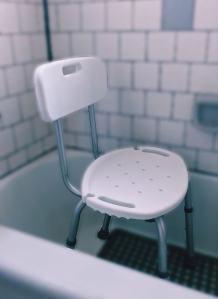
2. Shower chair: Weakness is common after surgery and with brain surgery compromised equilibrium expected. Having a shower reduces the chance of falls. You may need assistance with showering at first regardless, but having a shower chair allows more independence as you get further in your healing journey.
Safety First
3. Wound Wash (Benzethonium Chloride) Antiseptic Spray: Keeping your wounds clean is crucial to prevent infection. Showering every day is recommended, but your wounds can still become dirty. This spray not only cleans and keeps the area from getting infected, but also cools, and moisturizes the incisions. Having the incisions be moisturized and cool prevent unbearable pain and itching at a time you can’t be touching your incisions. You can purchase a can at your local Walgreens or CVS.
4. Ice packs: Prepare multiple ice packs, so you can rotate them to alleviate pain and reduce inflammation. Consider preparing different sizes. Some ice packs may fit on one side of your head, but not be effective on the top. Look at what shops have available, and see what may work best for you. There are also DIY ice packs made with water and isopropyl alcohol. Learn how to make your own by clicking here.
5. Recliner Chair or Electric Recliner: Sleeping with an incline helps reduce inflammation. However, getting in and out of bed post surgery can be challenging. A recliner allows easily conversion from upright to reclined during your recovery. If the recliner requires a lot of physical effort to move up and down, enlist someone who is with you during recovery to help you. An electric recliner would be preferable as it requires no effort on your part.
6.Sleep Mask: Anytime a skull is opened for surgery a small bit of air remains after closing. This is normal – sounds creepy, but normal. This tiny bit of air can cause migraines. Light sensitivity is a usual part of a migraine. Look for an eye cover that fits your head comfortably and blocks out light effectively. Keep in mind where your incisions will be when looking at fit before surgery. Anyone who experiences migraines knows that completely dark, sometimes isn’t dark enough.
7. All the Pillows: Finding a comfortable position can be challenging after surgery. Have on hand a myriad of pillows: wedge, neck, traditional, contoured memory foam, couch style etc. Having various pillow options, can increase your likelihood to prop in a comfortable and cozy position.
8.Button-up (or Zip up or Snaps) Shirts: Your head will be swollen and tender. This post-op time is a time to switch your tops to zip-ups or snaps or button ups for a It’s not often that you think about how the neck opening to a shirt glides along your head. You may be thinking “its just a few moments of contact, it can’t be that bad!”
9.Silk or Sateen or Satin Pillowcase: having a low friction pillow case allows your hair to move freely and have less of a chance of getting pulled or knotted. The material also stays a bit cooler which can make your head a bit more comfortable during the recovery process.
10.Support person: During the recovery process, physical limitations may make it difficult for your to manage alone. Recruit someone to monitor you for the first 24 hours, and be available to you for the first week after surgery. This support person, or team of people, should be the type that can help keep your spirits up remind you of all the progress that you have made. Recovery can be challenging and emotional, so having the support to relax and reduce stress is important to your physical recovery.
Bonus:Haircut: you don’t have to shave completely. My long locks were a huge part of my identity for the majority of my life. However, imagining my hair pulling on the incisions, had me cut it down to mid shoulder blade length. If I were able to go back in time, I would tell myself to cut more! So assess your hair density, length, and preferred style, and seriously consider going as short as you are comfortable with; then, maybe more.
By being well-prepared before your brain surgery, you can alleviate some of the anxiety and focus on a successful recovery. Have you gone through surgery recovery? What item was your must have? Comment below!















 Epil(epsy)ogue