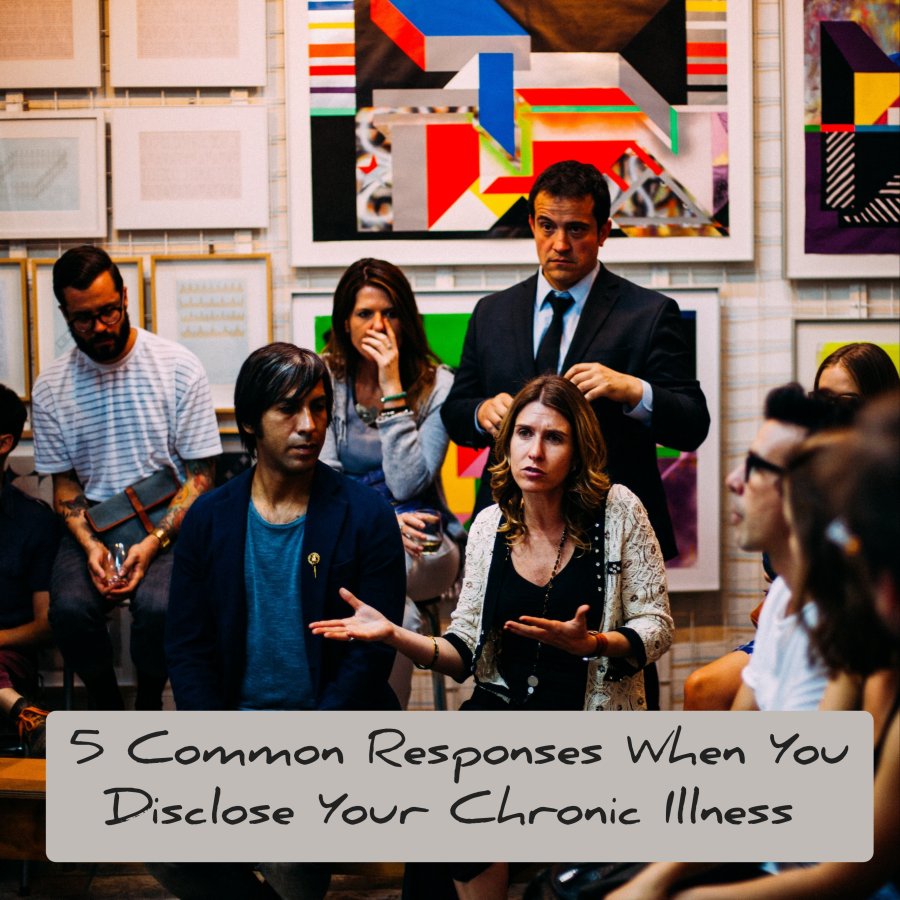
Woman speaking to crowd of people. The crowd has a wide variety of expressions on their faces.

Navigating Disclosure: 5 Common Reactions to Your Chronic Illness

Living with chronic illness comes with its own set of challenges, and one of them is dealing with people’s reactions when you tell them about your medical condition. Here are five common responses and suggestions on how to handle each situation.

1. β€œAt least it’s not cancer.” And if it is cancer, at least it isn’t this particular type of cancer, or you would have died already. It’s disheartening when others downplay your experience by comparing it to different conditions or other people’s situations.

Remember, their comments are not about you, but about their own discomfort with the topic of any chronic illness. For your own mental and physical health, it’s best to ignore these remarks.

2. β€œI know the cure.” They had a cousin, who knew a guy, whose wife did this regimen and now she’s cured! So you should definitely do that so you can get cured too. (Even though there is no cure to your illness.)

Many well-meaning people may suggest unproven remedies or miracle cures, despite lacking any medical knowledge about your condition. Politely acknowledging their advice while asserting that you have a team of medical professionals guiding your treatment can help maintain boundaries and prevent further unwanted recommendations.

3. β€œWell, you don’t look sick.” This response stems from their preconceived expectation of how chronic illness β€œshould” look, and if you don’t fit inside their stereotypes, it causes people to doubt your experience. Educating as many people about not all illnesses are visible may foster understanding.

But if you have already calmly explained the concept of invisible illness and how it impacts your daily life and they still do not believe you, it is best to accept that not everyone will comprehend your personal trials.

4. β€œTell me more about…” Some individuals genuinely want to learn about your condition. While it might be intimidating at first, try to embrace these opportunities to educate others about your chronic illness. Increasing awareness can combat misconceptions and help create a more compassionate environment. If you find reliable resources, apps, websites, even influencers that provide accurate information about your specific chronic illness, so you can help educate others, Who knows, they may even become advocates to raise awareness in turn!

5. β€œYour struggles are powerful.” Over-sympathizers might shower you with well intentioned prayers and sentiments, but their constant emphasis on your epic struggles can be overwhelming. They may have the best intentions, yet we do not need to be reminded that we struggle every day. We live it; we know. Remember that you are more than your illness, and it’s okay to politely remind them that you appreciate their support while still maintaining personal boundaries.

Have you encountered any of these responses when disclosing your chronic illness to someone new in your life? What was your response?


Frequently Asked Questions About Epilepsy

Is epilepsy just where you fall on the floor and shake? Epilepsy is a neurological condition that causes recurrent seizures. There are many types of seizures that present themselves in different ways. Most people are familiar with generalized tonic-clonic seizures, where a person loses consciousness and muscles get stiff and rhythmically jerk on both sides of the body. However, there are other types of seizures to be aware of:

  • Tonic seizures: muscles in body, arms, or legs become stiff or tense which can cause a fall.
  • Clonic seizures: rhythmical jerking movements in the arms or legs.
  • Infantile epileptic spasms: the body contracts and extends repeatedly; presenting like a startle reflex; this occurs within the first year of life.
  • Atonic seizures: muscles become weak, limp, or numb; these are also known as a β€œdrop seizure”
  • Myoclonic seizures: brief muscle twitching occurs while the person remains alert.
  • Focal Aware seizures: the person stays alert but experiences involuntary motor moments or sudden changes in emotional state, thinking or cognition, behavioral arrest, and autonomic function
  • Focal Impaired Awareness seizures: the person loses awareness, and likely will not remember the event; seizure can present as sudden changes in emotional state, thinking or cognition, behavioral arrest, and autonomic function
  • Absence seizures: these present as a blank stare and the person’s eyelids may flutter

I’ve just been diagnosed, where do I find support? Epilepsy Foundation is a United States based organization that has many resources for people and families impacted by epilepsy, in all age groups. You can visit their website to find the right support group for you by clicking here. They even have bereavement support for those who have lost a loved one to SUDEP.

What is SUDEP? Sudden Unexpected Death in Epilepsy. It is more likely to occur in people with poor seizure control and status epilepticus. According to the Epilepsy Foundation, more than 1 out of 1,000 people with epilepsy die each year from SUDEP.

I am on a medication, but its been 3 months and I am still having seizures. What can I do? Talk to your primary care physician or pediatrician, you may need to see an epileptologist (a neurologist who specializes in epilepsy) or neurologist at a level 4 Epilepsy Center.

What is a Level 4 Epilepsy Center? A level 4 epilepsy center is accredited by the National Association of Epilepsy Centers and provides the highest level of care for people living with epilepsy and other seizure disorders. These locations have advanced neurodiagnostic monitoring equipment. If surgery is a treatment option for a person living with epilepsy, it will be preformed there. You can find a Level 4 Epilepsy Center near you by visiting the National Association of Epilepsy Centers’ website.

When would surgery possibly be a treatment option for my epilepsy? That would be a decision between you and you medical provider. However, if you have tried 3 or more medications and they have failed to control your seizures, further evaluation is recommended at a Level 4 Epilepsy Center. This evaluation would likely include, neuropsycholoical assessment, genetic testing, Video EEG, CT, MRI, magnetoencephalography (MEG) and possibly other tests. Depending on your type and location of seizures your epilepsy team will recommend the type of surgery that would be most effective for you.

There is more than one type of surgery for epilepsy treatment? Yes, there are sever surgical options including device implants, laser therapy, disconnection, and resection or removal of the portion of the cause of the seizures. Depending on your testing results you may be a candidate for more than one of these surgeries. To read more about my surgery journey click here.

Is there a cure for epilepsy? No, unfortunately there is no cure for epilepsy. There are some very effective treatments (like those mentioned above) that do reduce seizure frequency and improve quality of life for approximately 60% of patients with epilepsy. It is important to work with a medical team that specializes in epilepsy and any other medical conditions you have to find the best treatment plan for you.

Multi color computer rendering of a brain in front of a purple background.

Do you have any questions about epilepsy? Let me know in the comments below, send me a private message via my contact form, send me a DM on Instagram or Twitter.

10 Things to Prepare Before Brain Surgery Plus One Bonus Suggestion

Undergoing brain surgery can be a daunting experience, but being well-prepared can help you feel more at ease heading into the process. You have read everything about the surgery itself. You have the instructions from the hospital, and the surgeon. But maybe you want a little more of and insider tip from someone who has been there, done that. Well you have come to the right place!

Here are ten essential things to get ready before your surgery, along with a bonus to consider at the end.

1. Baby (Gentle) Shampoo: Harsh chemicals can be detrimental to healing incisions. Baby or natural shampoos are usually safe, but please check with your surgeon if you are unsure. Liquid shampoo is easier to apply and spread to tender areas rather than a bar.

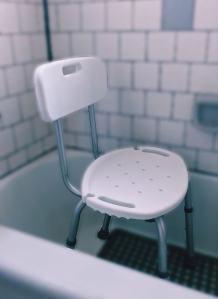
2. Shower chair: Weakness is common after surgery and with brain surgery compromised equilibrium expected. Having a shower reduces the chance of falls. You may need assistance with showering at first regardless, but having a shower chair allows more independence as you get further in your healing journey.

White shower chair sitting in a white tub with dark grey bath matt and white tile and dark grey grout.
Safety First

3. Wound Wash (Benzethonium Chloride) Antiseptic Spray: Keeping your wounds clean is crucial to prevent infection. Showering every day is recommended, but your wounds can still become dirty. This spray not only cleans and keeps the area from getting infected, but also cools, and moisturizes the incisions. Having the incisions be moisturized and cool prevent unbearable pain and itching at a time you can’t be touching your incisions. You can purchase a can at your local Walgreens or CVS.

4. Ice packs: Prepare multiple ice packs, so you can rotate them to alleviate pain and reduce inflammation. Consider preparing different sizes. Some ice packs may fit on one side of your head, but not be effective on the top. Look at what shops have available, and see what may work best for you. There are also DIY ice packs made with water and isopropyl alcohol. Learn how to make your own by clicking here.

5. Recliner Chair or Electric Recliner: Sleeping with an incline helps reduce inflammation. However, getting in and out of bed post surgery can be challenging. A recliner allows easily conversion from upright to reclined during your recovery. If the recliner requires a lot of physical effort to move up and down, enlist someone who is with you during recovery to help you. An electric recliner would be preferable as it requires no effort on your part.

6. Sleep Mask: Anytime a skull is opened for surgery a small bit of air remains after closing. This is normal – sounds creepy, but normal. This tiny bit of air can cause migraines. Light sensitivity is a usual part of a migraine. Look for an eye cover that fits your head comfortably and blocks out light effectively. Keep in mind where your incisions will be when looking at fit before surgery. Anyone who experiences migraines knows that completely dark, sometimes isn’t dark enough.

Woman sleeping with one arm over head with pink fuzzy eye mask in blue long sleeve shirt and white under shirt.
Photo by cottonbro studio

7. All the Pillows: Finding a comfortable position can be challenging after surgery. Have on hand a myriad of pillows: wedge, neck, traditional, contoured memory foam, couch style etc. Having various pillow options, can increase your likelihood to prop in a comfortable and cozy position.

8. Button-up (or Zip up or Snaps) Shirts: Your head will be swollen and tender. This post-op time is a time to switch your tops to zip-ups or snaps or button ups for a It’s not often that you think about how the neck opening to a shirt glides along your head. You may be thinking β€œits just a few moments of contact, it can’t be that bad!”

9. Silk or Sateen or Satin Pillowcase: having a low friction pillow case allows your hair to move freely and have less of a chance of getting pulled or knotted. The material also stays a bit cooler which can make your head a bit more comfortable during the recovery process.

10. Support person: During the recovery process, physical limitations may make it difficult for your to manage alone. Recruit someone to monitor you for the first 24 hours, and be available to you for the first week after surgery. This support person, or team of people, should be the type that can help keep your spirits up remind you of all the progress that you have made. Recovery can be challenging and emotional, so having the support to relax and reduce stress is important to your physical recovery.

You might consider…

Bonus: Haircut: you don’t have to shave completely. My long locks were a huge part of my identity for the majority of my life. However, imagining my hair pulling on the incisions, had me cut it down to mid shoulder blade length. If I were able to go back in time, I would tell myself to cut more! So assess your hair density, length, and preferred style, and seriously consider going as short as you are comfortable with; then, maybe more.

By being well-prepared before your brain surgery, you can alleviate some of the anxiety and focus on a successful recovery. Have you gone through surgery recovery? What item was your must have? Comment below!

3 Must Do’s When Living With a Chronic Illness

Trying to be “perfect” with a chronic illness is impossible. However, being open to learning about yourself, and adapting to your ever-changing situation, can help you thrive in ways that may seem unattainable. Here are three basic things that greatly help manage living with chronic illness.

Turn Bad Days Into Good Data

There are no avoiding bad days when you have a chronic illness. There is no doubt that a bad day can cause feelings of anger, frustration, and grief when losing another day to your condition.

One way we can turn them into a positive is by learning everything we can about those days. Analyze your day or week leading up to that bad day. Was it food, lack of sleep, and/or activity that triggered this bad day? If you are not sure, keeping track will help you see patterns you never noticed before.

Photo by Isaac Smith

Sometimes with chronic illness bad days happen for no particular reason. But perhaps you can find something that you have the ability to manage. Changing that one thing can perhaps decrease the frequency and severity of the bad day.

A health journal can be an ally in tracking your ups and downs. You can create a diary on paper, or look for apps that fit your needs. Along with tracking the “what went wrongs” do not forget to note the “what went rights.” Remembering to mark those positives can help maintain perspective.

Treat Your Emotional Health, Not Just Your Physical Health

With chronic illness you more than likely have been prescribed medication (or several) to treat your physical health. You have maybe changed your routine, or added an activity in your life to help cope with your chronic illness. But have you added anything to help improve your mental health?

Photo by Mike Erskine

Sometimes people feel like we must hide our illness, or just “tough it out” but that can be extremely detrimental to your mental health. Along those same lines, mental health can be extremely detrimental to your physical health.

Take the time to acknowledge your emotions, so that you can deal with them in a healthy way. If you are unsure how to start, reach out to a professional to help guide you in your mental health journey.

Be Forgiving

Would you treat a friend badly because they had to cancel plans because of their chronic illness? I assume not. So why would you be down on yourself when you have to? Treat yourself how you would treat a good friend in the same situation.

Replace judgemental thoughts with love and forgiveness. When you catch yourself saying or thinking a negative thought, stop, and reframe the thought. For example, I find myself thinking “I’m so pathetic” quite often.

When I catch myself in those moments I stop, take a breath, and change that thought. “I may not have been able to open the jar, but I tried, and asked for help when I needed it. And for that, I am proud of myself.”
This may seem difficult at first, but the more you practice, the easier it becomes. Eventually, you may even find yourself skipping the negative thought in the first place!

What are your “must do’s” in living with a chronic condition? Do you practice any of the above? Let me know in the comments below!

Photosensitive Epilepsy and Halloween Movies

The original idea for this post was to create a short list of Halloween movies that were safe for a person with photosensitive epilepsy. Photosensitive epilepsy is when sudden light/contrast changes trigger a seizure. 

What this post quickly turned into was a list of movies that were not safe for photosensitivity. Learn more about photosensitivity and seizures from the Epilepsy Foundation.

The spooky season comes with dangers when you live with epilepsy or migraines triggered by flashing lights. Strobe lights seem to be a staple in haunted houses. Lightening flashes are a common scary ambiance in Halloween movies. 

I watched each of these movies (I did so safely) to find these flashes. There were many of the classic movies that you wouldn’t expect that were disqualified from being photosensitive friendly. 

Although the movies below do contain some amount of flashing, watching the movie in a bright space lessens the likelihood of triggering a seizure or migraine. This is because the contrast difference is lessened. The 🌞 indicates that the movie is most likely safe for daylight viewing.

Disclaimer: Not all photosensitivity is the same.  You can use the below list as a reference if you are unsure of the photosensitivity safety. Please use caution when watching ANY movie if you are triggered by light changes.

Family Friendly Halloween Movies:

  • Nightmare Before Christmas
  • Hocus Pocus 🌞

  • Adams Family (1991)
  • Edward Scissor-Hands 🌞
  • Beetlejuice

Halloween Classics:

  • Halloween

  • Poltergeist
  • Ghostbusters
  • Evil Dead 2: Dead by Dawn

Modern Halloween Movies:

  • Underworld

  • Silent Hill
  • Tucker and Dale vs Evil 🌞

My goal is to watch almost every horror, thriller, slasher, and monster movie, in western culture, to grow this list.

There are movies that you can enjoy in the dark that do not have flashes. But that will be a (much smaller) list for another time.

What is your favorite Halloween movie? Is there a movie listed above, that surprises you that it is not photosensitive safe?

Chronic Illness: Expectation vs. Reality

Managing social expectations can be difficult when you have a chronic illness. Social expectations of what your illness “should” be like, can be greatly influenced by things seen on TV and movies. Unfortunately, many illnesses and disabilities get portrayed in just one way. And that depiction can sometimes be the only experience of an illness or disability someone has in their life.

You may have seen commercials for new medications that  have actors portraying your chronic illness. Sometimes it is hard to see a person in the commercial doing all these things that you cannot. People in those commercials always seem to have a positive attitude about their condition. 

You might see things on social media of people accomplishing milestones that you’re worried you may never get to. It is okay to feel frustrated. It is okay to feel hurt by other people’s experiences. No two people, and no two journeys are alike. 

What can we do to help when we are feeling like that?

Recognize how strong you are. Say to yourself “this is really hard, but I am working on it.” You are here in this moment, and you know what that means? You have been brave enough to not give up or give in to your disability or chronic illness.

Allow yourself to feel frustration, disappointment, anger, etc. Don’t let somebody tell you that your emotions are bad or invalid. You are going to feel, however you are going to feel. Practice not pushing the emotion away, or pushing the emotion down. But also practice not clinging to that emotion or holding grudges. I say practice, because this will take time to get better at accomplishing.

Focus on what you know to be true in this moment. Try to avoid thinking only in extremes. For example “I never will” or “it is wrong that” or “it is not fair that” are parts of extreme thinking. Remind yourself of the good you have right now. Read more about stating your one good thing here.

Finish by thinking of pleasant things that you can do today that makes you feel good. And acknowledge how amazing and wonderful it is that you can do that. There are many activities that can bring joy that don’t require much effort, but can bring much joy. Can’t think of anything off hand? The following list contains Covid-19 restriction friendly suggestions.

  • Singing (regardless of talent level)

  • Talking with a friend (on the phone or in person)

  • Day dreaming (stick to good thoughts)

  • Gaming (board or video)

  • Playing with pets (this is good for them too)

  • Reading (books or blogs – like this one!)

  • Napping (one of my favorites)

  • Learning something new (language, hobby, musical instrument)


Here is my example of using the above technique: I see people who are days, months, and years seizure-free via social media. Right now in my life I’m lucky to go a couple of hours seizure-free. Therefore, I can feel quite discouraged and jealous at times.

But, the fact that I can help bring awareness about the different experiences people have with epilepsy, and other chronic illnesses makes me feel proud. Helping more of the general public be aware that not all epilepsy looks the same, is very rewarding. 

My hope is, with more education, social expectations will be more realistic. My truth in this moment is: I know I have the capability of reaching towards that goal, with this blog. It is hard, but I am working on it.

Having a chronic illness comes with a lot of unpredictability. You may not know what the future may hold. But together we can work on bringing more joy and comfort in the now.

What are some frustrations you experience with your, or a loved ones chronic illness? Do you think you will try what was discussed above in those moments? Feel free to share in the comments.