Oral health and Epilepsy

Taking care of your teeth is important for everyone, but it can be particularly challenging if you live with a condition that causes involuntary clenching or grinding of your teeth. Did you know that dentin, the substance that makes up the bulk of your teeth, is the hardest substance in your body (with bone coming in second)? When you have a medical condition like seizures, it’s essential to take extra care of your oral health to avoid injuries and long-term damage. In this post, we’ll explore some practical tips to help you care for your oral health.

Photo by Pixabay

Find a good dentist. Having a good dentist as a part of your healthcare team is crucial when dealing with a chronic illness that affects your oral health. Be sure to inform your dentist of all your medical conditions. Seizures themselves can cause oral injuries. Some anticonvulsant medications have oral health side effects. Working closely with your dentist, you can help make a plan for oral health that fits your unique situation.

Get a mouth guard. Using a mouth guard can be a game-changer if you experience clenching or grinding of your teeth due to seizures. Your dentist can customize a mouth guard specifically to your mouth and needs, or you can buy one over-the-counter and custom-fit it yourself. Your dental insurance may even cover the cost of your guard, or at least reduce it. If you choose to buy one over-the-counter, just know that getting the perfect fit takes a lot of patience so be sure to read instructions that come with the kit.

A mouth guard can help prevent irreversible enamel damage caused by seizures, as well as prevent any further wear and tear on your molars. Talk to your medical professional to see if a mouth guard would be beneficial for you, and don’t hesitate to ask your dentist for advice on choosing the right type of mouth guard for your needs.

Use an Electric Toothbrush. Using an electric toothbrush can make brushing easier and more effective, especially when you’re dealing with a medical condition that affects your oral health. The oscillating and rotating motion of an electric toothbrush can help remove more plaque and bacteria from your teeth, giving you a cleaner, healthier smile. If you can afford the luxury of an electric toothbrush, it’s worth investing in one. Look for one that has soft bristles and multiple speed settings, and consider getting one with a timer to help you brush for the recommended two minutes. With proper use and care, an electric toothbrush can last for years, making it a smart investment in your oral health. Just don’t neglect to floss just because you have a fancy new tool!
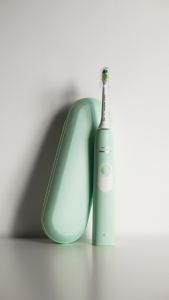
Mint Green Electric Toothbrush
Photo by Cristi Ursea on Unsplash

What is the best thing that you have done for your oral health? Do you see the dentist at least once a year like the American Dental Association recommends? Comment below!

3 Must Do’s When Living With a Chronic Illness

Trying to be “perfect” with a chronic illness is impossible. However, being open to learning about yourself, and adapting to your ever-changing situation, can help you thrive in ways that may seem unattainable. Here are three basic things that greatly help manage living with chronic illness.

Turn Bad Days Into Good Data

There are no avoiding bad days when you have a chronic illness. There is no doubt that a bad day can cause feelings of anger, frustration, and grief when losing another day to your condition.

One way we can turn them into a positive is by learning everything we can about those days. Analyze your day or week leading up to that bad day. Was it food, lack of sleep, and/or activity that triggered this bad day? If you are not sure, keeping track will help you see patterns you never noticed before.

Photo by Isaac Smith

Sometimes with chronic illness bad days happen for no particular reason. But perhaps you can find something that you have the ability to manage. Changing that one thing can perhaps decrease the frequency and severity of the bad day.

A health journal can be an ally in tracking your ups and downs. You can create a diary on paper, or look for apps that fit your needs. Along with tracking the “what went wrongs” do not forget to note the “what went rights.” Remembering to mark those positives can help maintain perspective.

Treat Your Emotional Health, Not Just Your Physical Health

With chronic illness you more than likely have been prescribed medication (or several) to treat your physical health. You have maybe changed your routine, or added an activity in your life to help cope with your chronic illness. But have you added anything to help improve your mental health?

Photo by Mike Erskine

Sometimes people feel like we must hide our illness, or just “tough it out” but that can be extremely detrimental to your mental health. Along those same lines, mental health can be extremely detrimental to your physical health.

Take the time to acknowledge your emotions, so that you can deal with them in a healthy way. If you are unsure how to start, reach out to a professional to help guide you in your mental health journey.

Be Forgiving

Would you treat a friend badly because they had to cancel plans because of their chronic illness? I assume not. So why would you be down on yourself when you have to? Treat yourself how you would treat a good friend in the same situation.

Replace judgemental thoughts with love and forgiveness. When you catch yourself saying or thinking a negative thought, stop, and reframe the thought. For example, I find myself thinking “I’m so pathetic” quite often.

When I catch myself in those moments I stop, take a breath, and change that thought. “I may not have been able to open the jar, but I tried, and asked for help when I needed it. And for that, I am proud of myself.”
This may seem difficult at first, but the more you practice, the easier it becomes. Eventually, you may even find yourself skipping the negative thought in the first place!

What are your “must do’s” in living with a chronic condition? Do you practice any of the above? Let me know in the comments below!

I’m trying minimalism (to see how it would impact epilepsy) so you don’t have to.

My chronic illness causes constant fatigue. My body is battling itself from the inside, and it’s hard to deal with anything on the outside. Housework falls by the wayside; it is just too hard to make things happen. Everyday I got to see things getting piled up larger and larger, waiting for the time that I felt good enough to do something about it. And that time rarely comes.

One day I took a good long look at my house, and my life, and finally decided I needed to do something drastic to help me. What I ended up looking in to, was minimalism. At first I thought, “how ridiculous? I love the majority of my items in my home, I will never be able to part with them. I should just give up now.”

As I read, I found minimalism didn’t mean living with nothing, it meant living with less.

Research shows brain fatigue increases when it has to process more in an environment. Brain fatigue means body fatigue. Studies have found that clutter in a space raises cortisol levels. Cortisol is your stress hormone. Therefore clutter hits you with a double whammy, to your physical and mental health.

The more I thought about it, the more it started to look good for my epileptic brain. With things being simplified and reduced in my house, my brain would not need to use as much energy (because it really does not have any to spare). 

So, this is where we started.

Chalk board reminder if our Keep It Conditions.

Set some guidelines to help you out with the decision making process of what to keep, donate, or trash. Actually write these down, so that you have something visual to reference. Our guidelines are: 

  • Have I used this in the last year? Will I use it in the upcoming year?
  • Can it be replaced for less than or equal to $20? Can it be borrowed?
  • Would I purchase this item again?
  • Is this living out the purpose for which it was created? Or have I found a better use for this and it is currently doing its job?
  • Am I keeping it out of guilt?
  • if I had the opportunity, would I sell it in a yard sale?
  • Could somebody else use it or love it more?
  • Does it “spark joy”? (Inspired by the KonMari method)

My largest collection that sparks joy is my wardrobe. I love my clothing. I do not buy an item of clothing that will not create at least three complete outfits with the clothing items that I currently have. I am truly a curator. 💁🏽‍♀️

However, I do hold onto my items of clothing for decades. I’m not kidding, I have T-shirts that I wore in the 5th grade. (And yes they do still fit; I went through a very early growth spurt, and then never grew again.) 

So some items of clothing are clearly made for a younger person, and I am holding on to them purely for selfish nostalgia. That is where those questions come in. “Could someone else use or love it more?” 

Two bags of clothes ready for donation next to Al the avocado plant.

Most definitely, yes.

I feel better knowing that I’ve donated them and somebody else will wear and love them the way they should be loved.

The majority of my newer wardrobe has been left untouched, but a lot of other items have been donated, easing the stress of both me and the bar that holds my clothes!

Onion method is not called The Onion method because it’s stinky and makes you cry, it is because you focus on your house layer by layer. Start with the large items, or the items that you can easily identify that do not belong in that space.

Here are some items I found in my living room.

Left to right: Hair tie, Jack-o’-lantern necklace, mailbox key, kangaroo pencil, camera lense cover.

It is September, so that Halloween necklace has been out for almost a year. How embarrassing! 🤦🏽‍♀️ But it has a home in the Halloween decoration box in storage. The extra camera cover belongs in the camera bag, the pencil belongs in the office, the hair tie belongs in the bathroom, and the mailbox key belongs in the key bowl. And done! That’s five things already cleaned out of my living space! Small victory, but it feels pretty good.

Starting in the space where the smallest amount of work, makes the most visually impactful change, can be a great kickstarter. We donated a lot of clothes, but we don’t get to admire the closet like the clear space in the living room.

It is the room we hang out in the most as a family. Moving those 5 items made a clear open space that I can admire while the family spends time together. And this can be now more quality time because none of us are distracted by the mess that we are surrounded by.

The 15 minute rule. Limit yourself to 15 minutes at a time. Set a timer, and work consistently for that 15 minutes. If that is all you can manage for that day, it is absolutely fine, you did an amazing job.

Metallic Sandtimer – Not 15 mins.

In the beginning, that’s all I could manage. My body would get fatigued, or I just felt that I could not bring myself to do any more work. But I quickly found myself able to extend that 15 minutes. And not only physically I was able to, but I actually wanted to!

I’m not too sure if simplifying will help me as drastically as others. Regardless, I am sure that the benefits, no matter how small, would be worthwhile.

This is where we will start. I’ll give updates about this journey. I hope you are as excited as we, to find where this experiment brings us!

What is the level of clutter in your house? Do you have any tips on how to simplify that you find helpful? Let us know if you try any of the methods above, and how well it worked for you! 

Dallas’s Story

My partner “happened to be” looking at adoptable dogs on the Animal Humane website. He turned the phone to show me a picture of a catahoula puppy. He looked pathetic: skinny, scared, in need of support. Dallas was his shelter name. Something drew me to him immediately. I saw him the next day.

Skinny, scared, young catahoula dog.
Actual picture published on the Animal Humane website.

Animal Humane has a survey about what you as an adopter, are looking for in a dog. My answer: one who could go on outdoor adventures, travel with me, be my best friend always. When the employee asked if I was there to see someone in particular, I said Dallas. She laughed and said “you are not going to get all that from him!” My husband and I were confused as to why she would say that.

They put us in a greeting room, and we waited as they went to go get him. One he came in I realized what she had meant. He was being carried, unwilling to walk.

Being abandoned during critical development puppy years clearly caused some damage. At only 6 months old, he was frightened by the world that had been so cruel.

He laid on the floor in a little ball, untrusting, understandably. Attempting to not stress him more, we waited for Dallas to feel safe before I tried to pet him. Therefore, my husband and I sat on the floor next to him, and calmly had a conversation.

It took 25 minutes for just one leg to relax. Even then, treats we offered him were highly suspicious and gentle touches caused flinches.

We eventually moved to an outside space, and by that I mean he was carried, while I walked. Outside he was more comfortable; he was on all fours and he interacted much more. Our presence was becoming more tolerable to him. Surprisingly, he actually wanted loves, then he would go sniff, and come back for more loves.

At one point a bird flew towards us causing a very visual and emotional reaction from me. (I have an irrational fear of birds). Dallas immediately ran over to me to see if I was okay. I knew I was bringing him home. 

My parents and their dog are a big part of my life, so a meeting with them was crucial. Like always, their dog enjoyed having a friend. However, afterwards, my parents told me I was crazy to take on a dog that would require so much work. I didn’t care, I already loved him. 

He did require work. At home, everything was new and scary. Open doorways were impassable, floor changes were debilitating, learning how to be a dog was overwhelming. 

I hired a trainer for assistance, which was life changing for the both of us. He helped us in experiencing the world in a safe and confident manner. One session he mentioned how wonderful Dallas would be as a therapy dog because of his empathy.

Taking that opportunity, I asked how well he would be as a service dog, revealing that I have epilepsy. That was not something I did comfortably at that point in my life. Epilepsy was not something I had accepted yet. My trainer assured me that medical alerting would be a job in which he would excel. 

In only one year of training, Dallas was confident and proud! He was alerting me before episodes, and keeping me safe during seizures. Adopting him that day at Animal Humane I knew I was saving him, but I could never have expected that he would be saving me. We go on outdoor adventures, he travels with me, and he will be my best friend, always.

Woman and service dog
Dallas at the Walk to End Epilepsy 2019 with Sāb.

If you would like to donate to the Animal Humane visit their Donation page. Or volunteer at your local shelter.