4 Refreshing Benefits of Moving Into a New Space

A cozy living space with a stack of cardboard moving boxes next to a small potted plant and a yellow couch.

Moving into a new home is more than just unpacking boxes—it’s an opportunity to re-imagine your life and the way you live it. Whether you’re settling into a cozy apartment or upgrading to your dream house, this blank canvas comes with incredible advantages. Here are four powerful benefits of moving into a new space, and how to make the most of them.

Intentional Living: Design with Purpose

1. Each room in your new home is a fresh start. Think intentionally about how you want to use each space—what do you envision doing there? Maybe that sun-filled room with wide windows becomes your morning coffee haven or a creative workspace. 

Pro tip: Start simple. Only bring in furniture and decor that serves the space’s purpose. And remember, your first choice doesn’t have to be permanent—your needs and lifestyle may evolve, and your home can evolve with them.

A cozy interior featuring a decorative shelf with orange storage boxes, books, and plants, alongside two acoustic guitars and a painted artwork on the wall.

Spark Creativity with Signature Pieces

2. Let the items you love inspire the entire room. Is your bold red armchair your favorite? Or maybe that blue-green art piece holds sentimental value? Use these cherished items as anchors for your design decisions.

Avoid this common mistake: Buying curtains or rugs before knowing how your signature pieces will fit in. Build your space around what you already love—this saves time, money, and stress.

Declutter and Purge

3. Moving is the perfect time to ask: Does this add value to my life—or just take up space? Hopefully, you’ve already donated items that no longer serve you. Unpacking becomes much easier when you’re only surrounded by what truly matters.

And don’t worry if you second-guess things post-move. We’ve all looked at that one item and thought, “Why did I bring this?” Use it as a cue to keep editing your space until it feels right. If you need inspiration or help with decluttering or are interested in minimalism check out my attempt at minimalism.

A woman sitting on the floor in front of three cardboard boxes labeled 'keep', 'donate', and 'trash', surrounded by clothes and a natural decor background.

Embrace the Joy of Experimentation

4. One of the best parts of a new space? The freedom to explore. Try new arrangements, paint colors, or furniture placements without fear of getting it wrong. Your first setup doesn’t have to be final—it’s just your first chapter.

Let go of perfection. Your home isn’t just a showplace; it’s where your life unfolds. Have fun with it. Every tweak brings you closer to a space that truly feels like you.

Final Thoughts


A new space offers the gift of reinvention. With intention, creativity, clarity, and playfulness, you can create a home that supports the life you’re building now—and the one you’re dreaming of.

What are your best tips for moving into a new space? Comment below.

I Stretched Every Day for 31 Days, This is What Happened…

I am the epitome of idleness; not because I am lazy but because of my chronic illness. My uncontrolled epilepsy causes multiple seizures throughout the day and status epilepticus at night, leading to constant exhaustion. Even a simple task can consume all my energy, let alone anything physical. Just existing uses up more energy than the average person.

So I challenged myself to stretch every day for 31 days, to see if it could make a difference. Now, 31 days does not create a habit. It takes anywhere from 18 to 254 days, as science suggests. Nonetheless, I wanted to try to condition my body to a point that stretching wouldn’t seem like extra effort.

What does stretching do to your body?

The muscles are a fascinating fiber in our body. When we stretch, the fibers have the ability to maintain elongation, unlike a rubber band that just snaps back to its original shape. However, to maintain that elongation, regular movement within that range is necessary.

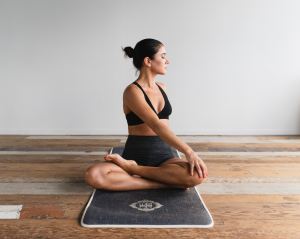
Woman sitting on hardwood floor, legs crossed, with her body gently rotated as she stretches her back. One hand is resting on her left knee, and her eyes are closed, looking relaxed. Yoga mat beneath her, with a light grey wall in the background.
Photo by Dane Wetton

As we age, the elastic fibers in our body regenerate less effectively, causing a reduction in movement range and muscle stiffness. Thus, movement and stretching become increasingly important as we grow older. For more information on the significance of movement, check out my other article Movement Matters.

Week 1

Initially I was unsure of how to begin. With no established routine, I was randomly stretching exercises. Then, I discovered a free app called Female Fitness – Women Workout. It offers targeted stretching routines such as full body, morning warm up, sleepy time stretch, and even splits training. It was the perfect place to start for the person who lacked direction. I also found a YouTuber who specialized in stretching techniques which allowed me to gain more knowledge along my journey. Below, is one of his videos of a easy 10 minute stretch, for any skill level, if you are interested in checking out his content.

Week 2

During this week, something surprising happened – I began to look forward to stretching. I found myself taking breaks to stretch my body, and even found ways to incorporate stretching while working. At this point I had established an actual stretch routine. Here were my rules:

  1. Engage my entire body in stretching – this did not apply to the stretches I did while I was still actively working at my computer or doing another activity. This meant I was dedicating time to actually do a full body stretch.  
  2. No time restrictions. – I wanted to stretch until I felt good, not until the clock/timer said I was done.  
  3. I stretched to discomfort, not pain. Once the discomfort disappeared, I would push a little further.

Week 3

By week three, a shift occurred in my mindset. I no longer needed the distraction of YouTube to complete a stretching session. It was the first time my body had moved since my brain surgery, and I never rebuilt an emotional connection to physical movement. But when I focused on how I felt, physically and emotionally as I flowed from one position to the next, I realized it was a peaceful experience.

Fit woman lying on a yoga mat, performing a supine spinal twist with a serene smile on her face. A soft beam of light from an out-of-frame window illuminates the wall and gently crosses her body, adding a dynamic touch to the tranquil scene
Photo by Miriam Alonso

Week 4

After consistent stretching, I began to see physical results.  I even noticed a significant difference in my overall flexibility. Am I ready to join Cirque Du Soleil? I think not. But incorporating movement into my day made a difference. Even the smallest amount of movement of our body can increase blood and fluid supply to our bodies. The small results I achieved during these 31 days have motivated me to continue stretching beyond this challenge.

What kinds of benefits do you find from stretching? I would love to hear about your stretching routine, leave it in the comments below!

3 Must Do’s When Living With a Chronic Illness

Trying to be “perfect” with a chronic illness is impossible. However, being open to learning about yourself, and adapting to your ever-changing situation, can help you thrive in ways that may seem unattainable. Here are three basic things that greatly help manage living with chronic illness.

Turn Bad Days Into Good Data

There are no avoiding bad days when you have a chronic illness. There is no doubt that a bad day can cause feelings of anger, frustration, and grief when losing another day to your condition.

One way we can turn them into a positive is by learning everything we can about those days. Analyze your day or week leading up to that bad day. Was it food, lack of sleep, and/or activity that triggered this bad day? If you are not sure, keeping track will help you see patterns you never noticed before.

Photo by Isaac Smith

Sometimes with chronic illness bad days happen for no particular reason. But perhaps you can find something that you have the ability to manage. Changing that one thing can perhaps decrease the frequency and severity of the bad day.

A health journal can be an ally in tracking your ups and downs. You can create a diary on paper, or look for apps that fit your needs. Along with tracking the “what went wrongs” do not forget to note the “what went rights.” Remembering to mark those positives can help maintain perspective.

Treat Your Emotional Health, Not Just Your Physical Health

With chronic illness you more than likely have been prescribed medication (or several) to treat your physical health. You have maybe changed your routine, or added an activity in your life to help cope with your chronic illness. But have you added anything to help improve your mental health?

Photo by Mike Erskine

Sometimes people feel like we must hide our illness, or just “tough it out” but that can be extremely detrimental to your mental health. Along those same lines, mental health can be extremely detrimental to your physical health.

Take the time to acknowledge your emotions, so that you can deal with them in a healthy way. If you are unsure how to start, reach out to a professional to help guide you in your mental health journey.

Be Forgiving

Would you treat a friend badly because they had to cancel plans because of their chronic illness? I assume not. So why would you be down on yourself when you have to? Treat yourself how you would treat a good friend in the same situation.

Replace judgemental thoughts with love and forgiveness. When you catch yourself saying or thinking a negative thought, stop, and reframe the thought. For example, I find myself thinking “I’m so pathetic” quite often.

When I catch myself in those moments I stop, take a breath, and change that thought. “I may not have been able to open the jar, but I tried, and asked for help when I needed it. And for that, I am proud of myself.”
This may seem difficult at first, but the more you practice, the easier it becomes. Eventually, you may even find yourself skipping the negative thought in the first place!

What are your “must do’s” in living with a chronic condition? Do you practice any of the above? Let me know in the comments below!

Bad day? Four tips to have a brighter day.

It was early, the sun was shining ☀️, the birds were singing 🐦. But I must have gotten out of bed on the wrong side. Every little thing was irking me. My partner was complaining about his back, again. He was trying to help me with something on my phone and all I could focus on was his coffee breath. ☕ Dallas went out to pee, and he was sniffing the bush for what I thought was for-ev-er.
My partner even told me he donated $100 to a local 8-year-old rock climber, who was crushed by a boulder and lost her leg. All I got was annoyed that he didn’t use his $100 elsewhere. (Like for food for people during this Covid time? Not sure I actually had an idea in mind. Again, I was just being a grouch.)
That’s what I knew I needed an attitude adjustment. How can any human be annoyed from somebody helping an eight year old girl in need? Had I suddenly turned evil overnight? Most likely not, I just desperately needed a change in mindset. 🧠


So how do we help ourselves when we feel that the world cannot do anything right?

Be aware of your words and your actions. The good news is that you realize you are grumpy. And grumpy might be an understatement… However you have the advantage here because you can recognize this. Keep that awareness; be very careful how you treat and talk to the people around you. Try to keep in mind that they are not meaning to annoy or hurt. Unless you have been very mean to them already, I’m sure they don’t even know that you’re feeling this way. You can inform them that you need a little bit of space in order to get yourself back to a not easily activated state. Be honest, tell them that there is nothing that they can do. It is best to just let you have your space at this time.

Change your atmosphere. Okay so you can’t quite just get back into bed, close your eyes, open them and literally get out on the other side of the bed, and all will be fixed. But you can change the environment that you’re in right now. If you can be outside, and breathe some fresh air, do so. Let some sun beams melt that ice on your heart. 😎 But please wear sunscreen!

Do one activity that you know always makes you happy. You know that one scene in the movie that always makes you laugh out loud? Watch that scene. Do you have a video game that you can immerse yourself in and remove yourself from reality for a moment? Play it. Are you a workout junky that gets that endorphin kick when you do 2000 jumping jacks? Jump away! Read more about how movement matters to improve mood.

Fake it ’till you make it. A wiser fella than myself once said: start with the actions, and the feelings will follow. Start with a small grin. Voice appreciation for the small things. Soon you may find yourself truly smiling and aware of the better, brighter day you are having. 🌞

How do you usually turn your frown upside down? If you use any of these tips, let us know in the comments!

5 Things to Keep You Safe During Reopening

The world is beginning to open back up. However, this does not mean that the virus is gone and everyone is safe again. Here are 5 simple things to keep yourself as safe as possible while entering into the new world.

  1. Practice good hand hygiene. You have done so well in the past 2 months teaching yourself to wash your hands efficiently and completely. Don’t let that great habit die! 
  1. Continue to wear your mask while in public. Don’t touch your face or mask unless you have freshly washed hands.
  1. Keep physically distanced in public spaces. Is the beach absolutely packed and you have to sit within 3 feet of 3 different groups of people? Maybe you can soak up the ocean fun another day. Be flexible on your adventures, and aim for more open space and less crowded places. It may be disappointing that plan A was a no-go, but plan B is just as exciting! Just be sure to plan for both before leaving the house.
  1. Take advantage of contactless pick up/ delivery. As more people are out and about, more people are exposed. It is great that your favorite restaurant is back in business; but the best way to support the community is to keep yourself and others safe and healthy.
  1. Trust your gut. Only you know what is safe, and what is too risky for you. Don’t feel pressured by friends and family to go out if you feel like it is too soon. Be honest to the people in your life; if they love you, they will understand.

What are your plans now that things are opening up? Feel free to share in the comments.

How to Focus on the Positive (in a time of Negativity)

“Just focus on the good”. – Advice I’m sure you have heard before.

Kind of a hard thing to do right now in the world. All the scary and bad thoughts that can easily occupy your mind. Everything and everyone is focused on the Coronavirus how terribly it is affecting the world. So if everyone and everything is having you focus on the bad, how are you supposed to get your mind at ease, and off of this pandemic?

The simple answer: change of mindset.

The better answer: small steps can help in changing your mindset.

This will not happen overnight. This is something that takes practice, and dedication. Dedication to see the good. This does not take more than a few moments, and you don’t need any special equipment. 

Right now change of mindset might seem like an overwhelming task. But all you need, is one. One good thing. 

How do you find your good thing of the day?

First assess who you are, where you are, and what you have in this moment. 

Is there someone in your life that is always your support? Have you accomplished something that maybe was a bummer doing, but you are proud that it’s done? Did someone say or do something that made you smile? 

Even if you’re something good is simple as: I had good snuggle time with my dog today. That’s where I need you to start – smallest things. Overtime reflecting on your day it will get easier, and you will find more, or bigger good things. I promise.

Enlist the help of your family and friends to start getting in the habit reviewing your one good thing of the day.I practice at the end of every day with my husband. But as long as we have been practicing, even we found we forgot to think of our one good thing, once this virus stopped the world. 

But being dedicated to our mental health, we picked it back up. Don’t let a slight lapse in practice discourage you. Just start again and let you one good thing of the day be that you are back focused on remembering your one good thing!

You’ve got this, friend. So go out there, and be prepared to start counting your good things!

Anything you can think of right now as your one good thing? Share it below in the comments.

Dog Days of Quarantine

Physical (formerly known as social) distancing is important to keeping yourself safe and healthy. However, it can get lonely, and let’s admit, even downright boring staying at home. We at least have the ability to watch movies, cook, bake, and play games to keep us from going stir crazy. But what about Fido?

We must remember our furry friends during this isolation process. Filling their basic needs of shelter love and food, may not be enough during this time. Meaningful interactions and continuing to maintain social order in the home help keep your dog calm and less anxious through this big change in his life.

Routine

Routine is important for dogs. Now that we find ourselves at home for a large amount of time we need to establish new routines. Did you used to feed your dog every morning right after you showered? Maybe you can incorporate the same ritual but in different steps. 

Now that you are waking up later, you can feed the dog right when you wake up. This gives you time to hang out in your PJs and drink a cup of Joe before you shower. It may take some time for doggo to get used to, but in time he will realize this is the new normal. 

Walk

Although we are practicing social distancing, most of us in the United States are still allowed to leave the house recreationally. This means we can take a S-T-R-O-L-L! We have to spell the word “stroll” because the dog now knows how to spell walk, and knows what it means. Scary, sometimes, how smart they are, right?

If you decide to take that walk, be sure you pass people on the sidewalk with at least 6ft between. Do not go to dog parks, or other highly visited spaces. 

Play

Although we cannot visit public spaces like dog parks, it does not mean that Fido cannot get the excitement of play. They need the mental and physical stimulation in order to regulate their behavior at home.

A longer walk can tire Fido out. If you take a longer walk, be sure to listen to your dog’s body language and not expect too much from him in the beginning, if he is not in shape. Work up slowly to longer walks. 

For a change in pace, try a short activity at a higher energy level. Maybe you have been itching to dust off those old roller-blades, skate boards, or even bikes out for Pups to run beside. Be sure you teach him how to join you safely to avoid getting tangled up. Don’t forget your safety gear! While you both are having fun, be sure to pay attention to his body language to know when to stop, and let him set the pace.

Bath

Hygiene is imperative, more so now than ever, and not just for those of us without paws. A dog’s skin health is a big influence in overall happiness. Perhaps you took Puppers to the groomer every week. Now that you are sheltering in place, a trip to the groomer is not feasible. 

If an outside bath is possible, try to reduce water waste by running the hose in the lawn, or dumping bath buckets in the garden. Before putting the used water in the lawn or garden, check to see if your dog shampoo is safe for plants.

Perhaps an indoor bath is preferred. If bathing in a sink or bathtub, clean the surfaces after use and check drains for hair clogs. At my house, my husband has to pull out the big clogs – I just don’t have the stomach for it!

Treats

Speaking of stomach… It is hard to resist those puppy dog eyes! I know I have fallen victim to them plenty of times. But we must resist. In order to keep Dog at a healthy weight, we can not overdo it with constant treats. 

Encourage good behavior with treats. Use treats to teach a new trick or brush up on service dog assistant tasks.  As long as treat giving remains constructive, it is unlikely that you will overdo or over indulge.

Personal Space 

Personal space is something that is important to us all. Having the family home all day can be stressful on your dog. We need to respect their personal space as we expect them to respect ours. Love and affection is wonderful to give a dog again but make sure to notice their behavior and understand when they need a little bit more space.

A Brave, New World

We all wish that we could speak to our animal and explain what is going on in the world. We want to tell them that although we are stressed and scared there is no reason for him to be, because we will keep him safe. But we cannot speak to them, which is why it is so important to let our actions do the communicating.

It is a weird, weird world, and it is constantly changing. For the foreseeable future, this is the new normal. If we remain confident our furry family will settle in with us.

Because the best way to lead is by example.

Hello World!

This is my first post so bear with me!

Nice to see you here! My name is Sāb (like babe but with an S). I have epilepsy with unusual seizure activity. It is uncontrolled and medication resistant.

Why did I tell you this, before anything else about me?

  • Because I thought it defined me.
  • Because I used to keep it a secret, thinking it was something to be ashamed about.

But that is a thing of the past! I now realize that although epilepsy has a big impact on my life, I have no reason to hide or be apologetic. It was a long journey to get here, and my adventure is not over.

I think it is important to recognize that it is an amazing feat, and I would love to share my experiences with you. My lessons learned, my “should’a, would’a, could’a’s” and future endeavors are the types of things I hope to publish.

Maybe you or a loved one have epilepsy, or some other chronic illness. You may find something of value hidden in my pages. I sure hope so.

I must admit, I have hoped to find some comfort out here in the infinite internet. If you have too, and you landed here, maybe there is a reason. I would love to connect.

So who am I really?

  • My educational background is in engineering
  • I have a wonderful and supportive family
  • I love to ice skate
  • My favorite place in the United States is the White Mountains in New Hampshire
  • I am looking into going back to school (for a mid-life career change)

Okay, those are just facts, not really allowing you to know the “real” me. I suppose that if you would like to get to know me, you can read my blog. Shoot, you can even contact me, and we can build a real friendship!

Regardless, I am hoping that you are willing to take this wild ride called life with me.

Stay tuned for the next episode (yes that was a seizure joke).